Monday, February 10, 2014
Saturday, February 1, 2014
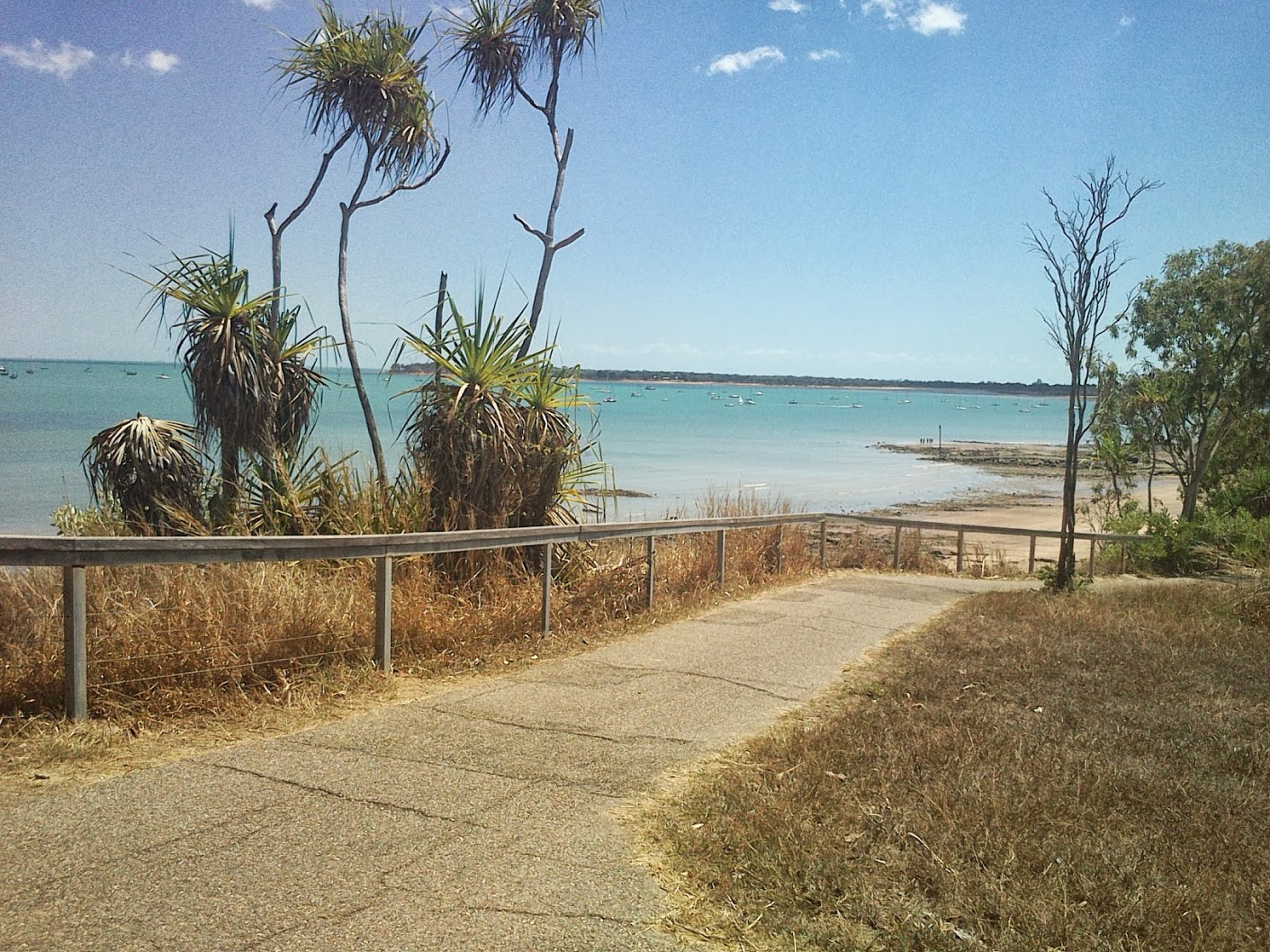
Ian Fairweather Walk
Image courtesy of theaustralian.com.au
Well done Darwin Council for allowing us to remember this great artist.
Brief summary:
Fairweather (born in Scotland 1891-1974) arrived in Australia in 1933.
Fairweather was a soldier in WW1 and was captured as a POW and during these four years of capture he was allowed to draw and he studied Japanese and illustrated POW magazines. After the war, he studied at the finest art colleges in Europe and this is where his wandering existence began. He frequently lived in extreme poverty and worked odd jobs.
He studied Chinese calligraphy which was a major influence on his work.
The Walk
The Fairweather Walk commemorates Fairweather's journey from Darwin Harbour across the Timor Sea, destination Timor.
He built a small raft from aircraft fuel tanks, driftwood and a recycled silk parachute as a sail. He set sail for Timor in 1952 at the ripe age of 60. Coming close to being lost in the Indian Ocean and being circled by shark safter 16 days at sea, he managed to wash up on the small island of Roti.
The Indonesian Government were not impressed resulting in Fairweather spending two months in an Indonesian jail. He was then deported to England.
Fairweather then returned to Australia in 1953 and spent his remaining days living a solitary life in a thatched hut on Bribie Island, just north of Brisbane. It was on Bribie Island that he created most of his most prolific painting over 21 years.
It is said that he is inspired by a myriad of influences from his early travels but specifically Chinese calligraphy.
Ian Fairweather | Kite flying 1958 | Synthetic polymer paint and gouache on cardboard laid down on composition board | 129.4 x 194cm | Purchased 1985 with the assistance of funds raised through a special Queensland Art Gallery Foundation appeal and with a contribution from the Queensland Art Gallery Society | Collection: Queensland Art Gallery | © Ian Fairweather, 1958/DACS. Licensed by Viscopy, Sydney 2011.
One of his paintings from 1961, Monastery acquired by the National Gallery of Australia was described by critics at the time as a masterpiece.
Fairweather's style has been described as being a sophisticated clumsiness. He often used materials that were readily available - cardboard or newspaper and the cheapest paints which resulted in many of his works being lost or damaged due to the tropical climate.
Fairweather is represented in all state galleries in Australia, the Tate Gallery, London, City Gallery, Leicester, and the Ulster Museum, Belfast. Ironically, the only exhibition of his own works he ever saw was an 1964 retrospective at the Queensland Art Gallery.
This is a very brief snapshot, for more information on ye old sailor and adventurer see http://www.ianfairweather.info/
Monday, January 27, 2014
Thursday, January 23, 2014
Nostalghia - Andrei Tarkovsky
Wow.
I stumbled across Nostalghia by Andrei Tarkovsky (1983) recently and am floored by the cinematography and frames.
Cinema as poetry.
Pure beauty.
Sepia tones.
Oh the beautiful melancholy.
I stumbled across Nostalghia by Andrei Tarkovsky (1983) recently and am floored by the cinematography and frames.
Cinema as poetry.
Pure beauty.
Sepia tones.
Oh the beautiful melancholy.
Thursday, January 9, 2014
Tropical Architecture study by Casey Temby
This can be viewed more clearly here in my portfolio:
https://www.behance.net/gallery/DARWIN-TROPICAL-ARCHITECTURE-IDEAS/9339763
Since living in Darwin, I have been amazed at how unsuited the current residential and commercial architecture is to the climate.
The air is thick and humid in the tropics, the heat extreme, the wet is a welcome relief from the heat however it can be torrential, and extreme dust in the dry season. It is essential that air flows to cool things down but also for insects, as the tropics are a haven for mosquitoes. The environment is demanding especially on man-made environments.
* Elevation – prevent ants, vehicle shelter, play area, laundry, security, dust, and dissipation
These themes represent a typology that we sometimes associate with typical tropical architecture but nonetheless a common sense typology that is still relevant today.
An example of pre-Cyclone Tracey typical tropical architecture is Burnett House at Myilly Point that survived the Cyclone and the World War Two bombing.
Designing for the tropics
Stretching west down Myilly Point [in east-central Darwin] is a group of four tropical houses designed in 1937 by B.C.G. Burnett, principal Government Architect for the Northern Territory. His previous experience in China and Malaya enabled him to understand the local climate. He designed elevated houses with steep- pitched roofs and open eaves to catch the refreshing sea breezes. Further innovations included replacing the external walls with asbestos-cement [ie., fibrolite] louvres that could be adjusted according to the weather conditions. The living areas and bedrooms were separated by three-quarter height partitions to allow for cross-ventilation. Burnett's practical and aesthetic designs established a regional architectural style that continues to influence contemporary housing designs.
Burnett House with Louvered walls 3/4 partitions and louvres for air flow
My study does not consider urban density for example, tropical architecture for high density apartment blocks which is important for the future. It primarily looks at single dwelling structures. However, with future trends in architecture such as the invention of new materials and the use of new technologies perhaps tropical architecture will evolve into another typology that will be more suited to urban density amid the increased population forecasts.
The environmental factors must be taken into account when designing for the tropics and its extremities in weather but why has this been forgotten over the last few decades?
https://www.behance.net/gallery/DARWIN-TROPICAL-ARCHITECTURE-IDEAS/9339763
Since living in Darwin, I have been amazed at how unsuited the current residential and commercial architecture is to the climate.
Of course the rush to rebuild and rehouse the residents and services after Cyclone Tracey in 1974 was a necessity and the design of buildings was most likely an afterthought. Perhaps they were intended to be short-term buildings and then when things had stabilised these would be replaced with more thought out designed buildings. However, I am not sure if this is the rationale because I still see being built today the concrete blocks that are prevalent in every Australian city, even cities with completely different climates. Whatever the reasoning may be, today Darwin is left with these buildings that are not only an eyesore but also energy inefficient structures that leave a large footprint on the immediate environment.
This study examines tropical architecture in northern Australia and collates the ideas of others who have examined this topic before, resulting in a mock-up residential design. It is worth noting that I have not taken into account cyclonic architecture. In researching this topic, there was a scarcity of information on innovative tropical architecture. The National Archive of Australia, Darwin office housed some literature from the seventies focusing on residential housing design for Darwin which seemed to be the most informed, clear and comprehensive study and this paper refers frequently to its ideas.
The air is thick and humid in the tropics, the heat extreme, the wet is a welcome relief from the heat however it can be torrential, and extreme dust in the dry season. It is essential that air flows to cool things down but also for insects, as the tropics are a haven for mosquitoes. The environment is demanding especially on man-made environments.
These factors need to be taken into account when designing for the tropics and the main recurrent design themes from my studies are:
* Elevation – prevent ants, vehicle shelter, play area, laundry, security, dust, and dissipation
* Orientation – east/west axis
* One-room wide houses – promote cross ventilation
* External awnings
* Shade trees
* White roof (current movement in California)
These themes represent a typology that we sometimes associate with typical tropical architecture but nonetheless a common sense typology that is still relevant today.
An example of pre-Cyclone Tracey typical tropical architecture is Burnett House at Myilly Point that survived the Cyclone and the World War Two bombing.
Quote from the signboard at Myilly Point (above):
Designing for the tropics
Stretching west down Myilly Point [in east-central Darwin] is a group of four tropical houses designed in 1937 by B.C.G. Burnett, principal Government Architect for the Northern Territory. His previous experience in China and Malaya enabled him to understand the local climate. He designed elevated houses with steep- pitched roofs and open eaves to catch the refreshing sea breezes. Further innovations included replacing the external walls with asbestos-cement [ie., fibrolite] louvres that could be adjusted according to the weather conditions. The living areas and bedrooms were separated by three-quarter height partitions to allow for cross-ventilation. Burnett's practical and aesthetic designs established a regional architectural style that continues to influence contemporary housing designs.
Burnett’s selection of ideas and also the aforementioned themes on tropical architecture have informed my design process for a single dwelling home illustrated by basic conceptual sketches below.
The environmental factors must be taken into account when designing for the tropics and its extremities in weather but why has this been forgotten over the last few decades?
Adapted to to a tropical climate? A residential apartment building in Darwin
Perhaps it is the allure of cheap, quick real estate with the promise of making quick money from property, however how long can man conquer the environment? Perhaps it will take something like the NT Government’s current mini budget initiative to heavily increase power taxes for people to realise they cannot continue to live in energy inefficient buildings in which one leaves the air conditioning on all day and night. A move back to the traditional concepts of tropical architecture will hopefully be a more alluring proposition enabling Territorians to live more harmoniously with the environment.
Friday, October 18, 2013
Drawn from Life group exhibition
I was thrilled to be able to be involved in this exhibition at DVAA, Darwin organised by Darwin Life Drawing.
It was from 20 September 2013 to 10 October 2013 and I exhibited two pieces and sold the work below.
Meld
Pencil on acid-free watercolour paper
Wednesday, September 11, 2013
Thursday, June 27, 2013
Wednesday, June 26, 2013
Random International - Rain Room
Loving Random International work particularly the Rain Room, 2012, situated at the Barbican Concert Hall, London.
It explores the interaction between human behaviour and the installation and what interests me is the engagement of the senses.
As people progress through the space, the sound of water and a suggestion of moisture fill the air, before you are confronted by a carefully choreographed downpour that responds to your movements and presence.
People can play God for a little while. Let there be rain!
Check out also the beautiful McGregor, Richter & Random: choreographic interventions at the Rain Room, 2012.
More info
It explores the interaction between human behaviour and the installation and what interests me is the engagement of the senses.
As people progress through the space, the sound of water and a suggestion of moisture fill the air, before you are confronted by a carefully choreographed downpour that responds to your movements and presence.
People can play God for a little while. Let there be rain!
Check out also the beautiful McGregor, Richter & Random: choreographic interventions at the Rain Room, 2012.
More info
Monday, June 17, 2013
Villa Vals - Switzerland
A home that slices into the mountain, enveloped by its natural surroundings.
It has hints of Gordon Matta Clarke to me.

Subscribe to:
Posts (Atom)


.jpg)


.jpg)