Monday, November 26, 2012

Sidsel Becker

Photographs taken at nightfall in Copenhagen by Danish artist,director and scenographer Sidesl Becker


Sunday, November 18, 2012

Katharina Grosse

I stumbled across Katharina Grosse when I was given a book about her.
She is a Berlin based artist.
Grosse seems to airbrush anythign she can get her hands on.
The intensity, uniqueness, limitless quality and exuberance of her work fascinates me.


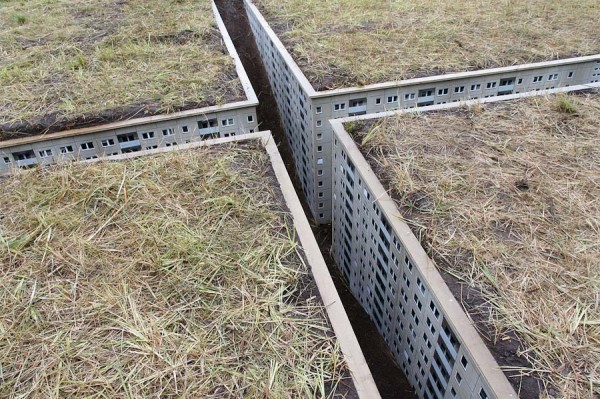
Building underground for urban density - future cities by Casey Temby

Could subterranean spaces for human occupation be a better solution than building up to tackle the problem of urban sprawl, and create urban density?
It would certainly free up land above ground for important purposes such as agriculture and parklands.

If you believe the reports that we are to expect more natural disasters in the future due to climate change, perhaps building underground is an attractive alternative.

When I first heard about this I was immediately intrigued and wanted to find out more.  I am always fascinated at how planners keep on creating suburbs on the outskirts of cities.  Think of the McMansions in the new 'burbs such as the Western suburbs of Sydney like Harrington Park.

This is an exciting yet challenging future for architects and especially interior designers.
How do you make these spaces habitable?
I would think the priority would be how to get natural light into the spaces and how to reduce the feeling of claustrophobia.

This idea seems to be permeating with city planners for example Helsinki's Masterplan in which to underground industrial facilities and data centres are stored underground  http://www.dailymotion.com/video/xh165b_helsinki-s-underground-master-plan_news

The Helsinki project puts industrial facilities and data centers below the surface in order to improve the quality of life above ground and maintain a nice cityscape. Data Centres are cooled by seawater and the heat created from the data centres is then pumped through pipes to warm cities above ground.

I see many positives with the underground model primarily being:
  • Reducing our carbon footprint and energy use
  • Freeing up space on the surface and conserving existing natural areas or restoring damaged areas which provides habitat and promotes biodiversity.
  • Reduction in the devastation to buildings from natural disasters.
  • Controlling erosion and stormwater runoff; often, this is done by covering much of the site with vegetation.

Could it be an ideal model for hot climatic areas such as the Northern Territory?
Understandably it would be a major shift in ideologies of living however is it achievable?

German street artist EVOl small scale model of an underground city
 http://www.architizer.com/en_us/blog/dyn/26677/an-underground-city-in-the-fields-of-hamburg/#.UKmTDGfbWUM

Further reading:
http://www.subsurfacebuildings.com/DiggingfortheGreen.html


Sunday, September 30, 2012

Spotted in Paris in September 2012 - Photography by Casey Temby

Bedside light, Five Hotel
E'claireur entrance foyer, Le Marais
Street art, Latin Quarter
Light installation, Les Jardin des Plantes
Cute
Installation at L'eclaireuer, Le Marais. Shop design is a fusion of art and fashion
Five Hotel
St Germain art

Thursday, August 23, 2012

lovely threads

wanting..
Alexander Wang trousers
Amen shirt
Ann Demeulemeester transparent dress

Dries Van Noten embroidered top
Dries Van Noten belt
La Maison Du Couturier dress
Erro dress
Ann Demeulemeester sandal
Christopher Kane tshirt

Thursday, March 22, 2012

Pierre Paulin 1927-2009


Admirable quote from an elegant, modest designer whom called himself un marginal or an outsider.
"It’s extremely dangerous to give too much importance and status to people who are only doing their job. Working for the enjoyment of the greatest number is very gratifying, much more so than any official honour.”
Paulin's iconic chairs often resembled tulips, tongues and mushrooms - how fantastique!

Saturday, December 10, 2011

My latest Interior Architecture project December 2011

A place to waste useful time
Garema Place - Canberra, ACT, Australia
site

tracing + analysis - disconnection, loneliness, grey, sensory deprivation, sunken, encroachment

Precedence
Concept- engage, elevate, interrupt man's circadian rhythm, enhance sensory, nature, voids, ruins, eliminating barriers: out-in-out, romance

'Self Storage' Design


My site model of Garema Place showing drabness, history of site such as a protest site, disconnection of people, transience of space.
Section model of my in-out-in space- blurring the interior and exterior - a public ruins-like space to waste useful time

Hand-drawn plans, section and elevations

interior perspective of passageway with push doors into Garema Place and ceiling openings giving views to the walkway above and letting light in.

Wednesday, May 25, 2011

Gallery Design

I thought I would add my latest Interior Architecture project in which the brief was to design a silversmith/ jewellery workshop, gallery and residence in a pre-exisiting building designed by the wonderful architect Enrico Taglietti (whom I had the privilege to interview in his studio!)
Copyright: my photo of Enrico Taglietti taken in May 2011

I will not include all of the boring intricacies of my design however I thought the photos of the model turned out quite interesting...

Themes of intrigue, mystery and drama are created through the use of light and lack of light and semi-transparent spaces. Once entering the space at the base of the stairs, the visitor is invited to travel down three dark meandering paths- left, right or straight. At the end of each path is an intriguing feature such as a glowing box or a hint of light, enticing the visitor to travel down the path to find out what is at the end, upon which they stumble upon something new and are invited to travel through another space.

The intent was to fuse public and semi-public spaces.


Jewellery intrigues.

Jewellery enhances.

Jewellery can be subtle or it can overpower.


The approach taken to this gallery design was one of a quiet, subtle, intriguing enhancement to the already existing building, without being overpowering.

The existing structure remains apparent. It lives and breathes. It is celebrated andadorned with glowing, wrapping, ornamentation.


"Everyone likes to own a jewel, but almost nobody talks about it. Natural modesty is one cause of this discretion, one may like to enhance oneself, to show off a precious stone or a design, but one waits for people to see it..."

Graham Hughes from "Jewelry' 1966