Monday, April 1, 2013

Gordon Matta-Clark (1943-1978)


Matta-Clark’s work is inspirational - the relationship between private and public space, the creation of sculpted voids, destructuring existing abandoned sites, interventions, the mystery of what is behind, ambiguous spaces, deconstructivist architecture.

His work tells a story of the previously inhabited spaces and of its inhabitants by exposing the layers of the building - he has been described as an urban archaeologist.

Matta Clark broke into abandoned buildings in NYC and cut large, geometrically shaped pieces out of walls and floors, sometimes slits through a whole building. This opened up the spaces to create unexpected views, sometimes through the whole building, plus exposing the hidden constructions and layers of the building. This created a play on light, with the light penetration creating sculpted forms allowing for a heightened sensory experience when in the building and new ways to perceive space.

I also like the realism of the work compared to a work being in a museum and Matta-Clark’s use of photography not only as a documentation of the physical pieces but also as an artwork itself.

Concical Intersect 1975
Schematic for Conical Intersect
Splitting 1974
Splitting 1974


Matta-Clark’s work informed and inspired me for one of my university projects:

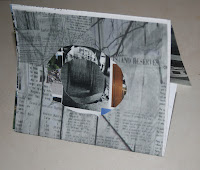
self storage Stop. Stay. Preserve

An urban public space to waste useful time. It uses the existing façade and create a ruins-like façade with sculpted void-like entrances. These are intended to blur the interior and the exterior.
The space endeavours to create a journey for the user, a place to slow down, engage with the space, work out where to enter, which direction to take, derive. An ambiguous space for the self - situationist concept.
There are glimpses through framed views attempting to convey the dada concept in which something is behind there.
Its relationship to the site is that the existing site is a high traffic, transient corridor for pedestrians, yet full of disconnection not only between people but also between the man-made and natural forms. There is a sense of encroachment by tall, grey ugly buildings and cement and concrete. All of this contributes to a confused sensory perception.
self storage design intention was to counteract the encroachment by opening up the space, using only the existing façade and opening up the inside with an internal central void and the use of sculpted cut out voids in the façade and second level walkways.
It counteracts the disconnection to place by slowing the user down, making one think about which entrance/ exit to take, thus a sense of arrival, what to do when inside.
Engage the senses through the use of, for example: an internal central garden for scent; play on light through the use of voids; touch through the use of swivel concrete push doors and benches.

It is an un-doing of the existing building as per Matta-Clarks philosophy.

    
self storage - A3 paper with designs on front & back, designed to fold up and has cut out holes

By un-doing a building there are many aspects of the social condition against which I am gesturing: to open a state of enclosure which had been preconditioned not only by physical necessity but by the industry that profligates suburban and urban boxes as a context for insuring a passive, isolated consumer—a virtually captive audience. 

Most importantly Matta Clark's site specific artwork has a sense of humour yet conveys social issues and is a vehicle for his ideology. It is full of puns which attracts me.

Sunday, March 31, 2013

Venus Water Mobile - Lotta Hannerz

Lotta Hannerz - Venus Water Mobile

I stumbled across this somewhat surreal sculpture when walking through Le Jardin du Luxembourg in Paris in 2006 with a friend. The Garden was incepted by Queen Marie de Medici during the 17th century.
It would have to be one of my favourite parks.

Hannerz's Venus is siutated in the Garden is at the Medici Fountain, which has a rich history itself. The Fountain is a 19th century permanent sculpture by Auguste Ottin,  (1811–1890) French academic sculptor and recipient of the decoration of the Legion of Honor.
Ottin's sculpture depicts Ovid's Metamorphoses - Greek mythology of the love story between Acis (spirit of the Acis River, Sicily) and the sea nymph Galatea and the giant Polyphemus sneaking up on the lovers. Polyphemus, Galatea's jealous suitor drives Galatea into the sea and crushes her sweetheart Acis to death with a boulder.
 Polyphemus Surprising Acis and Galatea, (1866), the Fontaine Médicis, Jardin du Luxembourg, Paris )

Hannerz’ gigantic temporary sculpture with lovely shaped nose lips and chin protrudes mysteriously from the water, floating lightly and seems to pay homage to the Medici Fountain story – Galatea rising from the water.Also the mythology of Venus (representing beauty, love, sex, fertility and prosperity) and Venus rising from the sea as a fully plays a part. The oraficial nature of the sculpture could also relate to the fragranced garden site.

The Birth of Venus, Botticelli, 1486

Coming from a props background, the theatricality of the piece and the production of this sculpture interests me. I would think the piece is originally made from chicken wire, followed by plaster and bandage,  and then clay to create the sculpture and sealed with shellac varnish.  The mould would then be taken, probably of plaster, moulded in separate sections and reinforced with fibreglass and resin. The mould would be left to dry then removed from the sculpture. The mould would then be filled with coloured fibreglass resin or possibly silicone to create the cast. The mould is then removed from the cast, and the cast painted with many layers to create the realistic flesh colours.

The sculpture stuck with me ever since I saw it. I was drawn to its romantic, melancholic, mysterious aesthetic and since researching, the sculpture is enriched by the site’s beautiful tragic love story. This acknowledgment and connection to the site makes the artwork appealing to me.

The work also strikes some similarities with Ron Mueck's work

  Jardin du Luxembourg, Paris (Luxembourg Gardens

Vincent Van Gogh painting of the gardens 1886


Friday, March 29, 2013

Joseph Griffiths - drawings


Jessie Trail - etching - 1912


Thursday, February 28, 2013

Photos from Sydney Feb 2013 by Casey Temby

Bronte from the 378 bus
The Blue Mountains
Potts Point hotel room


Tuesday, February 26, 2013

James Jean

Pauline
Choir

More info

Shift dress for Darwin weather

Charles Anastase printed linen dress with pockets - perfect attire for the Darwin wet season

Joseph Tawadros at Avatar Studios, NY with Bela Fleck, Roy Ayers & guests

A friend of mine sent me the music of Joseph Tawadros, Chamelions of the White Shadow.
This was recorded at Avatar Studios, NY with Bela Fleck, Roy Ayers and guests.

I had never heard of Joseph Tawadros and sometimes this is the way I like to discover an artist as there are no preconceptions. I prefer to launch straight into it and form my own opinions without being tainted by reviews and research.  So I had a small glance at the artist on youtube, pressed play and then closed my eyes.

I was taken to the streets of Paris, the markets of Istanbul, the jazz clubs of New York, Cuba and the toe-tappin' towns of Virginia and North Carolina.
But not only did I travel to these places, I travelled the world and also to the unknown where I have not even ventured to yet.  I am transported to a new place where things collide but form a coherent and captivating fusion and celebration.
A new place is created as is a new style of music, a fusion of bluegrass, acid jazz, afrobeat, rumba, flamenco, gypsy jazz, and even sometimes medieval-well to my ears anyway.

Sign me up for the magical mystery tour to this unbeknown destination!


Album sessions

The Silence Room

The Silence Room
Alex Cochrane Architects
A public space at Selfridges, London for people to escape the noise.
A minimal space with built-in seating almost entirely covered in feltt.
Celebrate the power of quiet.
DJs?

Saturday, February 2, 2013

Thursday, December 20, 2012

Otto Piene


More info

Monday, December 10, 2012

My new artwork for design competition

The competition was ran by a building company and an NT newspaper.
The winning work would be displayed on four 8x35m metal panels on the ends of two apartment towers in Darwin. 
The theme was loose but had to reflect the Territory in one way or another.
 The judges were to select 5 finalists and then the public vote for the winner, with the winner receiving $10,000.

I incorporated the building's name, Spirit & Soul into my concept: 

To me the strongest impression of Darwin that I first noticed when I moved here and will stay with me, is the contrast in weather and the feelings that the weather evokes - the red hot sunsets of orange, violet and pink hues; the stormy turbulent blue, grey skies that threaten to explode.  My atmospheric paintings show the varying skies that present themselves daily to Territorians.  I have attempted to express the colours of the skies and the feelings these colours evoke.
I believe the NT weather is part of Territorians' daily lives thus encompassing the spirit and soul of the Territory.
When the NT is discussed I find that we always, in some point of the conversation talk about the weather.  To me, this shows that it is an important and powerful theme, forming the spirit and soul of place and should be celebrated.
The four below represent the exciting constantly changing NT skies - vibrant sunsets and storm. I created them as diptychs.

I designed these to be in in 4 panels. 


Supporting concept photographs


I did not get through unfortunately. Here were the finalists..
 and the winner is....